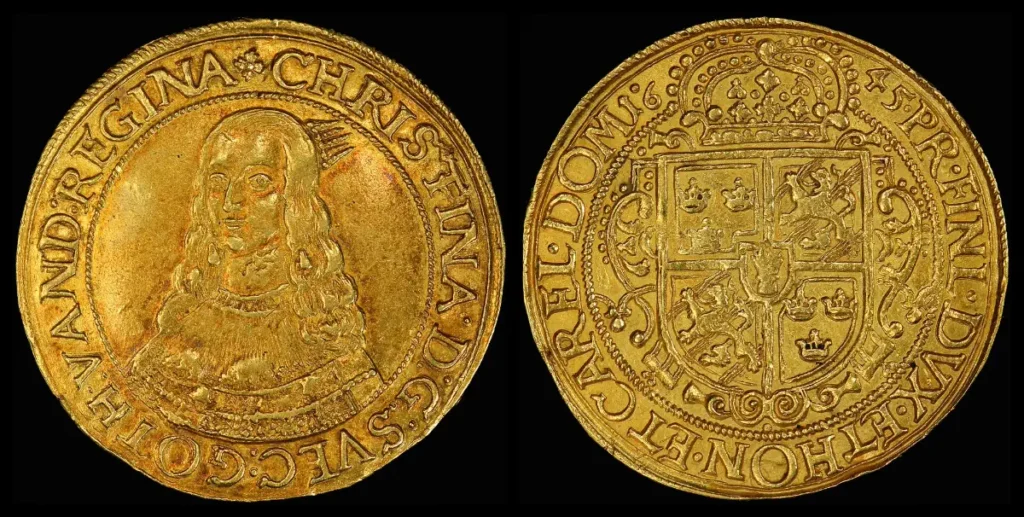
Disclaimer
This article is for informational and educational purposes only and does not constitute financial advice. The author may hold positions in the assets discussed. Any discussion on jurisdiction, exchanges or custody providers reflect the author's personal views and experiences and is not a personal recommendation. Always do your own research and seek professional guidance before making investment or custody decisions.
Last Updated on November 18, 2026
Sound money is money whose value cannot easily be altered by the people who issue it. The principles behind it are limited supply, costly production, easy verification and a credible promise of restraint.
For example, a Venetian gold ducat held about 3.5 grams of nearly pure gold from 1284 until the Republic fell in 1797. While the Roman denarius started at roughly 98 percent silver and, about two centuries after Nero first trimmed it, its successor coin held only a few percent.
Both were metal coins issued by governments, so it can’t be the metal that separated the ducat from the denarius.
Restraint was the key factor. Restraint rarely survives a war or a budget crisis on goodwill, so it has to be built into the structure of the money.
Sound Money Is a Constraint on the Issuer
People often assume that precious metals and sound money are the same thing. Not quite.
Gold and silver, for most of human history, became money because they had the attributes that best suited sound money:
- predictable supply
- costly production
- easy verification
- divisibility
- portability
Those properties explain why markets chose metal but they do not explain why metal money so often failed anyway.
They limit how much can be created and make fakes easier to spot but they do not stop an issuer from quietly redefining the unit, for example when a ruler puts less silver in each coin and keeps the name. The supply of silver may be fixed but the definition of the coin is an arbitrary human decision.
So soundness is better understood as the list above as well as a constraint on the issuer and the ability to stand up under stress.
The Six Tests of Sound Money
Test 1: Predictable Supply
The question: Can anyone expand the money stock at will, and if not, how fast does it grow?
Predictability matters more than scarcity itself. A family saving for 30 years needs to know roughly how the money will behave, not that its quantity is frozen. Gold grows by a small percentage each year through mining, and what makes that sound is that nobody can change the rate by choice. Cryptocurrencies grow in accordance with their code and for most, the rate of growth relative to existing stock slows over time.
Supply can fail from two directions. An issuer may expand it deliberately. Or nature may do so, as when the Spanish discovered the silver of Potosí in the sixteenth century and prices across Europe rose several-fold over the next hundred years or so. Historians still debate how much of that came from silver and how much from population growth, but the monetary effect was real.
Hard money like gold and silver can therefore lose purchasing power. What matters is that supply growth has to be slow, predictable and independent of any one party’s discretion.
Test 2: Costly Production
The question: What real resources does it take to create a new unit?
Cost is what turns a rule into a physical fact. If new units require labor, capital and energy, an issuer cannot enlarge the money supply by decree, and anyone who wants more must pay for it. Where creation costs almost nothing, restraint rests on promises alone.
However, this has a limit. Costly production constrains how many units are created but it says nothing about what each unit contains. For example Nero did not need to mine more silver to reduce the denarius, he just needed to put less of it in each coin.
Test 3: Easy Verification
The question: Can an ordinary user confirm the money is what it claims to be, without trusting the issuer?
Debasement works only when it goes unnoticed. Late Roman coins often had copper cores under a thin silver surface, so the shortfall showed only as the surface wore away. People who suspected the change spent the weaker coin and hoarded the stronger one, a pattern later called Gresham’s law, and the good money disappeared from circulation.
Verification is partly physical, as with a ridged coin edge that exposes clipping, and partly institutional, as with independent assays and public accounting. The weaker the checks, the more freedom an issuer has to cheat quietly. This is also why transparency of rules matters at least as much as the material.
Test 4: Divisibility and Portability
The question: Can it be split and moved in the amounts that daily life requires?
This is the test that explains why cattle and land, which pass the first three, never became money. A herd is hard to move and impossible to subdivide for a small purchase. Money has to work as a medium of exchange before it can serve as a store of value.
The test is relative, not absolute. Gold is more divisible than land and more portable than cattle, yet clumsy next to a digital balance. Often the practical answer has been to hold value in one form and transact in another. Which layer a family cares about depends on what it is trying to do.
Test 5: A Credible Promise
The question: If the issuer makes a commitment, who can make it keep that commitment?
A promise matters only if someone can enforce it. Convertibility, the right to exchange paper for a fixed weight of gold, gave holders a way to force the issuer’s hand. Without that right, the promise depends on the issuer’s goodwill, and goodwill is least reliable when it is most needed.
The gold standard demonstrates this pattern. Britain suspended gold payments in 1797 under the strain of war and resumed them in 1821. Bretton Woods tied the dollar to gold for foreign central banks until that link was cut in 1971. A rule holds when breaking it is costly to the issuer. When the cost to the issuer falls, the rule often bends.
Test 6: Behavior Under Stress
The question: What happens when keeping the rules becomes expensive?
Stress is where the other five tests are settled. Byzantium’s solidus held its standard for roughly seven centuries, then gave way in the 1040s when a sustained military and fiscal emergency made debasement the cheapest way to pay for defense. The rule did not fail through ignorance. It failed under pressure. Most sound money systems started to disintegrate because government books came under pressure.
Stress cuts both ways, though. A rule that cannot bend is brittle. In the 1930s, countries defending a fixed gold parity had to raise interest rates and cut spending as gold flowed out, which deepened the Depression. Economic historians such as Barry Eichengreen have shown that countries that left gold earlier generally recovered sooner. The rule that protected against issuer abuse also tied the money supply to the supply of metal.
The ideologically pure among us, would never want to consider rules bending or trade-offs. But I’m a realist. No sound money system has ever survived, at some point it has buckled and broken. Even Bitcoin, the best sound money in history is full of trade-offs. It’s the nature of life.
Monetary systems that survive the longest usually pair a firm rule with some way of bending, which is how debasement enters the picture. Having sound money does not mean removing the trade-off.
Applying the Tests Today
The six tests can be applied to any store of value, and they give different answers for different assets:
- Modern fiat currency is highly divisible and portable (Test 4) and easy to verify in accounting terms (Test 3). Its supply (Test 1) and the promises behind it (Test 5) rest on institutions whose rules can change.
- Gold has a long record of costly production (Test 2) and slow supply growth (Test 1), but it is harder to divide and move (Test 4).
- Bitcoin has a supply cap fixed in code and verifiable by anyone (Tests 1 and 3). It has less than two decades of history, and its price has been far more volatile than the other two, so Test 6 is largely untested.
None of this tells you what to hold. Without knowing your time horizon, liquidity needs and tolerance for risk, no one can say how those trade-offs should be weighed. Different people have reasoned differently across history.
A useful question for any holding is: what would I need to believe for this to work over the next 20 to 30 years, and what happens if I’m wrong?
For related frameworks, see Wealth Preservation Strategies.
Conclusion
The ducat and the denarius were both metal coins issued by governments. One held its standard for over five centuries and the other lost nearly all its silver in about two. The first four tests explain why metal became money. The last two explain why metal alone was never enough: someone has to be able to hold the issuer to its word, and the sound money rules have to be able to survive stress.
Money holds its value while its rules outlast its rulers, and fails when those rules bend too much under pressure and no one can enforce them. Rigid rules carry costs of their own, and who bears them has always been a political question.
I don’t know when or whether any particular system will face that test again. Nobody does. But I know the pattern, and it lets a people ask better questions than most people ask. That’s the whole point. The future is uncertain but with history and with probabilities of patterns repeating it’s enough to think clearly with, and plan.
Image Credits:
1645 Ducat is in the public domain


