Disclaimer
This article is for informational and educational purposes only and does not constitute financial advice. The author may hold positions in the assets discussed. Any discussion on jurisdiction, exchanges or custody providers reflect the author's personal views and experiences and is not a personal recommendation. Always do your own research and seek professional guidance before making investment or custody decisions.
Last Updated on April 17, 2026
Ancient currency collapses weren’t random catastrophes. Rather they followed a pattern so consistent it appears in every documented case from Athens to Rome to Ptolemaic Egypt.
Governments faced fiscal pressure and they responded by debasing their currency. Citizens subsequently lost trust in the currency and the economy unravelled. The fact that the cycle repeated itself across centuries and continents isn’t that suprising because human nature and the incentives of those in power haven’t changed.
The Roman denarius started at 95% silver in 64 BC. By 268 AD, it contained less than 5%. It was a gradual erosion of a currency that had anchored Mediterranean trade for centuries. Families who saved in denarii watched their wealth vanish. Those who held physical assets such as land, gold and goods survived.
This matters to us today because the pattern didn’t die in the Ancient world. The mechanics of currency debasement, the government’s incentive to inflate, the public’s gradual loss of trust and the flight to hard assets is identical whether you’re discussing the Antoninianus in 250 AD or fiat currency in 2026.
Ancient collapses aren’t just historical curiosities. They’re the longest-running dataset we have on what happens when governments control money supply.
This article will examine ancient currency collapses from the 4th century BC through to Rome’s final debasement around 500 AD. You’ll see the same pattern repeat. Understanding this pattern isn’t about predicting the future but rather about recognizing incentives that never change.
The Debasement Trap: Why Ancient Governments Always Chose Inflation
Every ancient government that debased its currency faced the same impossible choice:
- raise taxes directly and trigger immediate revolt; or
- debase currency and steal purchasing power invisibly
They all chose debasement. Not because ancient rulers were uniquely corrupt or incompetent, but because the political math made any other choice suicidal.
Wars demanded immediate funding and public programs created expectations rulers couldn’t abandon.
But tax bases were limited by agricultural productivity and primitive collection systems. Raising taxes openly meant armed rebellion and cutting spending meant losing military support or public legitimacy.
Without a bond market and the ability to borrow, governments of the ancient world had an even greater incentive to debase than their modern counterparts.
Debasement offered a seductive alternative. Reduce the silver content of each coin by 10%, and suddenly the mint produces 10% more coins from the same amount of metal. The government gets immediate relief. Citizens don’t notice initially—the coins look the same, weigh nearly the same, and merchants accept them at face value. The theft is invisible.
Nero understood this when he reduced the denarius’s silver content by 10% in 64 AD. Rome had burned and reconstruction required massive spending. Raising taxes after a disaster would have sparked riots. So Nero debased quietly, funding rebuilding on the backs of every citizen holding denarii. Most didn’t notice for years.
But debasement created a ratchet effect. Once the precedent was set, reversal became politically impossible. The next emperor facing fiscal pressure could point to Nero’s precedent. Why take the political risk of tax increases when debasement worked before? Each debasement made the next one easier to justify. Short-term relief compounded into long-term destruction.
Ancient rulers weren’t ignorant of the consequences. Domitian, who ruled from 81-96 AD, actually improved the denarius back to 98% silver purity, a remarkable act of fiscal discipline. But his reforms lasted only until the next major war. Fiscal pressure returned, and so did debasement. The incentive structure was stronger than any individual emperor’s will.
This explains why every ancient currency collapse followed the same arc. The mechanics of government finance created identical pressures across civilizations. Athens faced it during the Peloponnesian War. Rome faced it during the Third Century Crisis. The solution was always the same because the alternatives were always worse for the rulers making the decision.
Athens and the Peloponnesian War: Democracy’s First Currency Crisis
Athens in the 5th century BC was a superpower. The silver drachma, extracted from the rich Laurion mines, dominated Mediterranean trade. Athenian democracy was the envy of the Greek world. Then came the Peloponnesian War (431-404 BC), and fiscal pressure revealed that democratic governance offered no protection against currency debasement.
The war with Sparta drained Athens’s treasury despite the Laurion silver mines. Emergency expenses mounted. The democratic assembly voted for increasingly desperate measures. They melted down gold reserves. They seized temple treasures – sacred funds held in trust for the gods. And they debased the drachma.
Archaeological evidence shows “plated” coins from this period, bronze cores with a thin wash of silver. The technology was crude and the deception obvious upon close inspection. But in wartime commerce, merchants had little choice but to accept official coinage at face value. The alternative was refusing government payment, which invited severe consequences.
The interesting pattern here is that democratic decision-making didn’t prevent the debasement. The Athenian assembly voted for these measures. Popular sovereignty didn’t create fiscal discipline, in fact it undermined it. Voters facing an existential war with Sparta weren’t going to vote for massive tax increases. Instead they chose the invisible tax of inflation.
Athens’s currency crisis mirrored its military defeat. As trust in the drachma eroded, so did Athens’s ability to finance continued resistance. Allied city-states, already resentful of Athenian hegemony, had even less reason to accept debased coinage. The monetary breakdown accelerated political fragmentation.
This matters because it demonstrates that the type of political system, whether democratic or autocratic, has little bearing on currency stability. The incentive to choose inflation over explicit taxation operates regardless of who holds formal power. Voters and tyrants both prefer invisible theft to visible confiscation.
Dionysius I of Syracuse: The Tyrant’s Monetary Trick
If Athens showed that democracy couldn’t prevent debasement, Syracuse demonstrated that autocracy could enable even cruder monetary manipulation. Dionysius I’s scheme in the 4th century BC was so audacious it became a textbook example of government monetary fraud for 2,000 years.
Syracuse was wealthy, a major Greek colony in Sicily. Dionysius I was at war with Carthage, and wars consumed money faster than taxes could generate it. He needed immediate funds to pay his army and couldn’t afford the delay of raising taxes or the political cost of conscription.
His solution, preserved in Aristotle’s Politics, was brilliantly simple and completely fraudulent. He ordered all citizens to surrender their one-drachma coins to the government under penalty of death. Citizens, faced with execution, complied. Dionysius then restamped each one-drachma coin as a two-drachma coin. He repaid government debts at the new face value, keeping half the metal for himself.
The mathematics were elegant: instant 50% devaluation of every citizen’s savings. Dionysius turned one million drachmas of government debt into half a million by decree. Citizens who deposited one drachma got back a coin marked “two drachmas” but containing the same metal as before. Merchants quickly adjusted prices upward. Inflation ate the purchasing power of the restamped coins.
Why didn’t this work permanently? Because it destroyed trust in a single stroke. Unlike gradual debasement, which hides behind plausible deniability, Dionysius’s overnight redenomination made the fraud obvious. Citizens learned that government promises about currency value were worthless. They adjusted behavior accordingly by hoarding real goods, demanding payment in foreign coinage and reverting to barter where possible.
The lesson here is that governments can inflate once dramatically or gradually over time, but the effect on trust is the same. Quick debasement makes the theft obvious but slow debasement makes it no less real. Citizens aren’t stupid, they eventually notice, and they respond by abandoning the currency.
Modern parallels abound. Turkey’s currency “reforms” that removed zeros from the lira. Venezuela’s repeated redenominations of the bolivar. Zimbabwe’s astronomical revaluations. Even FDR’s famous revaluation in 1933.
The Roman Denarius: 400 Years from Sound Money to Worthless Metal
Rome’s monetary collapse stretched across four centuries, but the pattern compressed within it is identical to faster collapses. The denarius started as sound money and ended as a worthless token because the incentive to debase never disappeared.
In 211 BC, Rome introduced the denarius at 4.5 grams of 95%+ pure silver. The weight and purity created trust. Merchants across the Mediterranean accepted denarii because they knew the metal content. The currency’s stability enabled Roman trade expansion, tax collection efficiency, and military payment reliability.
Early Republican fiscal discipline maintained this standard. Balanced budgets were cultural imperatives. Debt was shameful. Wars were expected to pay for themselves through plunder and tribute. The denarius remained stable because Rome’s political culture punished fiscal irresponsibility.
Then came the transition to Empire and the slow erosion of that discipline. Nero’s 64 AD debasement, reducing silver content to 90% and cutting weight set the precedent. The drop was small enough that most citizens didn’t notice immediately. Merchants accepted the coins. Life continued. But the ratchet had clicked.
Second-century emperors mostly maintained Nero’s reduced standard. The “Good Emperors” (96-180 AD) kept the denarius relatively stable at 80-85% silver. This looked like success and a century of monetary calm. But the underlying dynamic hadn’t changed. Each emperor facing fiscal pressure had less reason to restore full silver content, more reason to maintain the inflated supply.
The Third Century Crisis (235-284 AD) exposed the system’s fragility. Fifty emperors in fifty years, most dying violently, each desperate for funds to pay armies. The denarius collapsed from 50% silver in 238 AD to under 5% by 268 AD. Caracalla’s Antoninianus, introduced in 215 AD as a “double denarius,” actually contained only 1.5 times the silver. Citizens weren’t fooled for long.
By 268 AD, the denarius was essentially bronze with silver coating. Archaeological coin hoards from this period show citizens burying good (older) coins and circulating bad (newer) ones. It was Gresham’s Law in action. Prices tracked the debasement: Diocletian’s 301 AD price edict listed prices 200 times higher than first-century levels. Inflation of 20,000% across two centuries.
Citizens developed survival strategies characteristic of all monetary collapses. They extracted thin silver coatings from worthless coins, which became a cottage industry of reversing government fraud. They became fluent in barter, the language of monetary failure. Long-distance trade contracted because merchants couldn’t trust distant payment. Cities shrank as commercial networks unravelled.
What’s remarkable isn’t that Rome eventually debased to worthlessness, what is remarkable is how long the process took and how stability lasted for as long as it did in the early years. Gradual debasement is more dangerous than sudden collapse precisely because it allows normalization at each stage. Each generation accepted a slightly worse standard as normal, making the next debasement easier. The boiling frog effect operated across centuries.
The Third Century Crisis: When Currency Collapse Met Political Chaos
The Third Century Crisis demonstrates currency collapse as both cause and effect of political breakdown. Bad money didn’t just reflect instability, it accelerated it, creating a self-reinforcing spiral toward total collapse.
From 235 to 284 AD, the Roman Empire experienced institutional meltdown. Fifty emperors in fifty years, most assassinated, none dying peacefully in bed. Each new claimant needed military support to seize power. Armies demanded payment. But the treasury was empty, tax collection had collapsed, and economic productivity was cratering.
Debasement offered the only available solution. Each emperor needed immediate funds to buy army loyalty. There was no time to reform taxation or rebuild trade networks. So they debased further, getting short-term relief at the cost of long-term destruction.
This created a vicious feedback loop. Debasement caused inflation. Inflation reduced real value of army salaries. Soldiers demanded payment in gold or older (better) silver coins, refusing the worthless new issues. Emperors needed even more currency to meet payroll at the new prices. More debasement followed. Repeat.
The economic consequences extended far beyond inflation. Provincial governors began hoarding good coins, sending bad ones to Rome. Gresham’s Law operated at empire-wide scale as sound money disappeared from circulation, driven out by worthless coinage. Regional fragmentation accelerated as distant provinces concluded that Rome’s money wasn’t worth accepting.
This matters for understanding currency collapse mechanics. The Third Century Crisis shows how monetary breakdown doesn’t happen in isolation – it interacts with political instability, military pressure, and administrative decay. Each problem makes the others worse. Currency debasement reduces government legitimacy, which reduces tax compliance, which increases fiscal pressure, which drives more debasement.
The social impact fell hardest on the small landowners, merchants, artisans, and urban professionals. These families held wealth in coins, contracts, and commercial relationships. All three collapsed simultaneously. The wealthy survived by holding land and physical goods. The poor had nothing to lose. The middle class was destroyed.
This pattern appears in every major currency collapse: Weimar Germany, 1940s China, 1990s Yugoslavia, 2000s Zimbabwe, 2010s Venezuela. The timeline compresses in modern collapses. What took Rome fifty years happens in five with fiat currency. But the mechanism is identical. Bad money doesn’t just steal wealth, it unravels the social fabric.
Diocletian’s Price Controls: Why Ancient Rome Couldn’t Decree Away Inflation
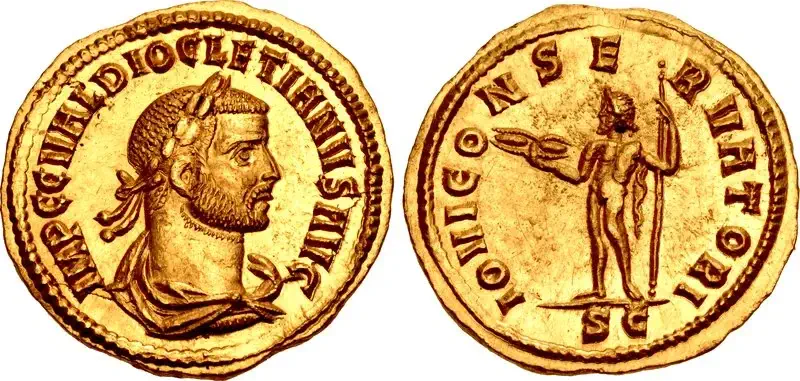
In 301 AD, Emperor Diocletian attempted to solve Rome’s inflation crisis with the Edict on Maximum Prices, a comprehensive price control decree listing maximum legal prices for over a thousand goods and services. Violators faced death. The edict failed completely, teaching a lesson governments have refused to learn for 1,700 years.
The logic was politically appealing: inflation was destroying the empire, so cap prices by law. Diocletian blamed merchants and speculators for high prices, not the decades of currency debasement that caused them. This blame-shifting is characteristic of the denial phase of currency collapse.
The edict specified maximum prices for everything from wheat to wool to prostitutes’ services. The penalties were severe, execution for selling above the cap. Diocletian genuinely believed this would restore economic order. He was treating symptoms while ignoring causes.
What happened? Goods disappeared from legal markets. Why would a merchant sell wheat at the legal maximum if that price didn’t cover costs? Better to hold the wheat, trade it on black markets, or simply produce less. Price controls created immediate shortages precisely because they prevented prices from performing their function of signaling scarcity and rationing demand.
Black markets flourished. The premium for illegal transactions reflected both scarcity and legal risk. Citizens willing to risk execution could buy goods at market-clearing prices. Law-abiding citizens went without. The edict created a two-tier economy: those with connections got goods at inflated black-market prices, everyone else faced empty shelves.
Within a few years, the edict was quietly abandoned. The historical record doesn’t specify exactly when enforcement stopped, which itself is telling as governments don’t typically announce the failure of signature policies. They just stop enforcing them and hope nobody notices.
The fundamental error was treating high prices as the disease rather than the symptom. Debasement caused inflation. Price controls didn’t address debasement, they just criminalized the market’s response to it. You can’t decree away economic reality. Prices reflect underlying scarcity and trust in currency. When currency is worthless, nominal prices must rise or markets cease functioning.
Modern parallels are everywhere from Venezuela’s price controls creating empty supermarkets to Nixon’s 1971 wage-price freeze causing shortages to rent control reducing housing supply. The policy fails every time for the same reason, because it attacks the consequences while leaving the causes untouched.
Why do governments repeatedly make this mistake? Because admitting monetary policy failed requires accepting political responsibility. Blaming merchants for “greed” or “speculation” is politically safer than admitting the government destroyed the currency. Price controls offer the appearance of action without addressing the underlying problem.
Constantine’s Gold Solidus: Abandoning Silver for Hard Money
In 312 AD, Constantine did what Diocletian’s price controls couldn’t. He acknowledged silver coinage was beyond saving and created a new gold standard. The solidus, at 4.5 grams of pure gold, became one of history’s most stable currencies, lasting 700+ years. But its success came at a cost – abandoning the middle class to inflating bronze.
The solidus represented an implicit admission that Rome couldn’t or wouldn’t restore discipline to the silver coinage system. Rather than fight centuries of debasement momentum, Constantine created a parallel currency system:
- Sound money in the form of gold for large transactions and government payments
- Worthless bronze for daily commerce
Why did gold work when silver failed? Physical constraints made the difference. Gold’s scarcity and easy recognition made debasement detectable. You can’t quietly reduce gold content without people noticing weight and purity changes. Silver’s greater abundance and lower value per unit weight had allowed gradual debasement to hide in plain sight for decades. Gold’s properties prevented that deception.
The solidus’s stability enabled the Byzantine Empire to function for seven more centuries. International trade resumed using a currency merchants could trust. Tax collection stabilized and provinces accepted payment in solidi. Military expenses could be calculated in real terms rather than constantly adjusting for inflation.
But this solution created a two-tier monetary system with stark class implications. The wealthy accessed gold for large transactions and wealth storage. Ordinary citizens remained trapped in the bronze economy, still experiencing inflation as bronze coinage continued to debase. The monetary system formalized wealth inequality with protection for the rich, exposure for everyone else.
This pattern emerges in every currency crisis as the flight to hard assets accelerates wealth stratification. Those with means can protect themselves by holding gold, land, foreign currency, or other stores of value. Those without means remain exposed to currency debasement, watching their savings and wages erode. Currency collapse is inherently regressive.
All you can do as an individual is try to put yourself on the side of those holding hard assets. It isn’t fair by any means, but it is the logial course of action.
Constantine’s gold standard also demonstrates that return to sound money is technically possible but it requires the political will to accept constraints. More importantly, the political will must endure beyond one administration.
Ptolemaic Egypt and Other Ancient Examples: The Pattern Repeats
Roman and Greek examples dominate ancient monetary history because their records survived. But currency debasement wasn’t a Mediterranean phenomenon, it appeared wherever governments controlled money supply.
Ptolemaic Egypt (305-30 BC) followed the pattern across three centuries. The Greek dynasty ruling Egypt progressively debased its currency as the regime weakened. Multiple reforms attempted to restore monetary order, each briefly successful but each eventually failing as fiscal pressures returned.
The telling detail was that Egyptian money wasn’t accepted abroad during later Ptolemaic rule. This “closed currency zone” signaled international distrust. Foreign merchants refused Egyptian coinage because they couldn’t trust its metal content. Egypt’s monetary system worked domestically only because the government forced acceptance. The moment Ptolemaic power waned, so did currency credibility.
Persian examples are less thoroughly documented but show similar patterns. Achaemenid and Parthian rulers faced the same fiscal pressures of wars, administrative costs across a large empire and limited tax capacity. Their responses followed the familiar path of debasement when pressure mounted and reforms when new regimes brought temporary fiscal discipline.
Chinese examples from the Warring States period (475-221 BC) demonstrate the pattern’s universality. Bronze coin debasement, government currency monopolies, inflation all appear in Chinese records despite radically different cultural context from Mediterranean civilizations.
The cross-cultural consistency matters. This isn’t about specific rulers or cultures or political systems. It’s about universal incentive structures. Governments everywhere face the same math. When expenses exceed revenues and explicit taxation triggers resistance, debasement offers temporary relief. The temptation to inflate is constant across time and geography. It’s human nature.
Skeptics might argue that ancient governments lacked modern monetary tools such as a bond market, central banking, economic data and macroeconomic theory. This is true but those tools haven’t changed the incentives. Modern governments face the identical pressures of deficit spending, political resistance to austerity and electoral pressure for relief.
The constraint ancient rulers faced, such as the physical limits on how fast they could debase silver, no longer exists with fiat currency. That makes modern debasement easier, not less likely.
What Ancient Collapses Reveal About Modern Fiat Currency
Ancient debasement was constrained by physical reality. You can’t create silver from nothing. Reducing metal content has limits as eventually you’re left with bronze coated in silver wash, and everyone notices. Modern fiat currency removes those constraints. Debasement is digital, instantaneous, and potentially limitless.
The incentives haven’t changed and modern governments face the same impossible choices that ancient rulers faced. Modern voters, like ancient citizens, prefer invisible inflation to visible tax increases. Politicians, like ancient emperors, prefer short-term relief to long-term sustainability.
The gold standard era (roughly 1870s-1914) represented a temporary exception where governments voluntarily accepted constraints on money supply. That system collapsed during World War I precisely because fiscal pressures made the constraints intolerable. Wartime governments chose inflation over gold convertibility, exactly as ancient governments chose debasement over fiscal discipline.
Every fiat currency in recorded history has eventually failed, with the exception of those still in ciruclation. That is a 100% historical failure rate. The modern dollar, euro, and yen have existed only for a few short decades. While that seems long compared to human lifespans it’s brief compared to the 2,500-year historical record of currency collapse.
The question isn’t whether modern fiat currencies face the same pressures as ancient ones, they obviously do. The question is whether modern institutions and tools can overcome those pressures. History suggests extraordinary skepticism is warranted.
How People Survived Ancient Currency Collapses
Archaeological and historical evidence shows which survival strategies worked during ancient monetary breakdowns. The patterns can inform modern thinking because the principles remain relevant. This is not financial advice – your individual circumstances will differ – but lessons can be learned from the study of history.
Land ownership consistently preserved wealth through currency crises. Constantine’s reforms favored large landowners because land retained value while currency didn’t. Roman estates survived the Third Century Crisis intact even as monetary wealth evaporated. Land can’t be inflated away. That is just as true back then as it is now. It can be seized, but it can’t be debased.
Physical gold and silver, when considering weight alone not government stamps, preserved purchasing power. Families hoarded older, un-debased coins. They held jewellery and bullion. When the official currency collapsed or was debased, these assets retained value because their worth derived from metal content, not from government decree.
Portable skills and trade goods maintained value through barter. Craftsmen, merchants, and professionals could trade services for necessities when the currency failed. A blacksmith’s skill remained valuable whether payment came in sound money, debased coins, or direct exchange of goods. That’s why some of the best advice you will hear in these difficult times is to invest in yourself and invest in your skills.
Geographic mobility mattered enormously, but it often required wealth and connections that most people lacked. Families who could relocate to more stable regions survived. Those trapped in collapsing economic zones had no exit.
Multi-generational wealth transfer through property and estates worked better than currency savings. Families who understood wealth as land, real assets and productive assets passed something tangible across generations. Those who saved in coins watched their legacy disappear.
What didn’t work was trusting government promises about currency stability, holding savings in official coinage or believing “this time is different.” The citizens who suffered most were those who followed official guidance and trusted institutional assurances.
The class divide was stark. Wealthy families had options as they could hold land, gold, and could relocate. They could wait out crises more effectively. Ordinary citizens were trapped.
Translating this to modern context requires acknowledging uncertainty. No one knows if fiat currencies collapse in 5 years or 50. But if you know the pattern you don’t need to. Holding hard assets that can’t be debased is the historical precedent and it worked.
Conclusion
Every ancient government facing fiscal pressure chose debasement. Not most of them, all of them. Every government blamed external factors such as profiteering merchants, foreigners or war, rather than accepting responsibility for monetary policy.
Every debasement eventually led to collapse or painful reform requiring return to commodity money. No ancient currency survived indefinitely.
The time horizon problem hasn’t disappeared. Currency collapse takes longer than political careers. Therefore individual rulers optimize for surviving their reign, not maintaining monetary stability for centuries. This incentive misalignment destroyed ancient currencies and it still operates in modern democracies. Elected officials face re-election before the long-term consequences of currency debasement manifest.
The difference between ancient and modern is degree, not kind. Ancient debasement was limited by physical constraints on metal manipulation. Modern fiat removes those limits, so the speed and scale are different, but the human incentives driving the process are identical.
Understanding ancient collapses doesn’t tell you when the dollar or euro fails. It tells you the historical base rate is 100% failure for government-controlled currency over sufficient time horizons.
You can’t change government monetary policy. But you can understand the historical precedent, recognize the pattern, and think through what makes sense for your family’s situation. Families who held hard assets during ancient collapses survived. Those who trusted currency didn’t.
Image Credits:
Aureus of Diocletian is in the public domain


