Disclaimer
This article is for informational and educational purposes only and does not constitute financial advice. The author may hold positions in the assets discussed. Any discussion on jurisdiction, exchanges or custody providers reflect the author's personal views and experiences and is not a personal recommendation. Always do your own research and seek professional guidance before making investment or custody decisions.
Last Updated on September 27, 2026
Between roughly 1500 and 1800 in what is known as the early modern period, European money failed in four distinct ways, and only one involved anything resembling a printing press.
People often assume that “hard money” like gold and silver was simply immune to failure because it was made of its certain metallic properties. But it wasn’t.
Precious metal coinage failed constantly in the early modern period. Not because the metal was fake or because it wasn’t the best material available. But because the people who controlled the coin had reasons to weaken it, and the people who used the coin usually found out too late.
Understanding how that happened — and why it kept happening even after each crisis was “solved” — says less about the early modern period than it does about how monetary trust works at all, in any era.
The Trade-Off Nobody Tells You About: Who Controls the Coin, Controls the Truth
Here’s the misconception worth clearing up first: a gold or silver coin isn’t automatically trustworthy just because it’s made of gold or silver. History shows that.
What makes it trustworthy is the claim stamped on its face — this coin contains X grams of Y purity — and whether that claim is true. And yes, that stamp is given by the government.
In the early modern period, the people making the claim about monetary purity were also the people with the strongest incentive to lie about it. Sovereigns held minting monopolies, and minting monopolies came with a temptation that predates paper money by centuries. Reduce the precious metal content of a coin while keeping its face value the same, and you’ve effectively created new money out of nothing.
No presses required. Just a slightly lighter coin and a public slow to catch on.
This is the trade-off that runs underneath every case study that follows. Debasement offered the crown short-term fiscal relief — a way to pay soldiers, fund wars, or cover deficits without raising visible taxes.
But it cost something less visible and far more expensive to rebuild. That is the willingness of merchants, farmers, and neighbors to trust the coin changing hands between them.
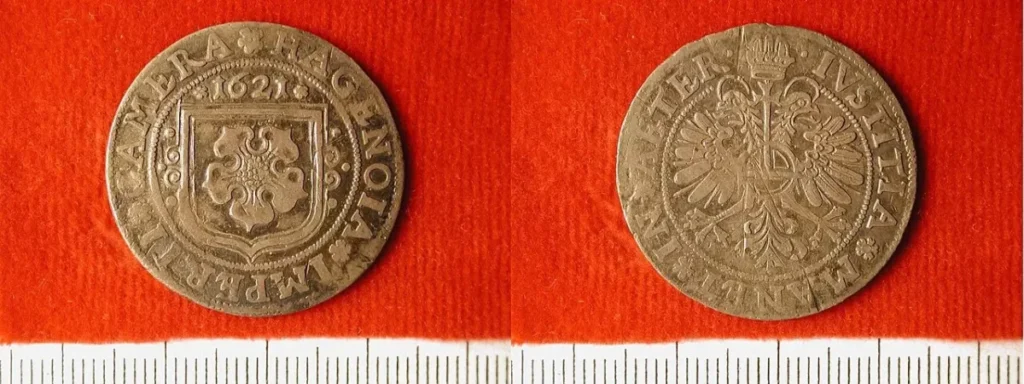
The Kipperzeit: When Debasement Became a Contagion (1618–1623)
The clearest early modern case study sits at the opening of the Thirty Years’ War, in the fragmented patchwork of the Holy Roman Empire. Instead of one central mint with one incentive to protect, the Empire had dozens of princes and mint operators, each with the legal right to strike coin — and each facing the same pressure to fund a war that showed no sign of ending quickly.
What followed is now known as the Kipper- und Wipperzeit, roughly “clipping and tipping time,” named for the practice of shaving or weighing coins to sort good silver from debased. Mint lessees figured out a profitable loop: melt down good, full-weight coin, reissue it at a debased standard, and pocket the difference. Because so many mints were competing rather than cooperating, this wasn’t a single policy decision — it was a race. Each territory had an incentive to debase faster than its neighbors, spend the debased coin across the border, and let someone else absorb the loss.
The results were what you’d expect once that race is understood as structural rather than accidental. Prices spiked in a manner that looked, to contemporaries, like the coin itself had gone insane. In some regions, trade reverted partway to barter because no one could agree what a coin was actually worth. And critically, the damage wasn’t contained to the debased coins themselves — confidence collapsed in circulating currency generally, because there was no reliable way for an ordinary merchant to tell good coin from bad on sight.
The lesson here isn’t really about Germany in the 1620s. It’s that decentralized authority over money doesn’t prevent debasement — it accelerates it, because no single issuer bears the full cost of the trust they’re spending.
The Price Revolution: When “Sound Money” Still Wasn’t Enough
The second early modern failure mode looks nothing like the first, and that’s exactly why it matters. No prince debased anything. The silver was real, the coins were full weight, and the purchasing power of European money still fell for the better part of a century.
The cause was Spanish America. Silver extracted from Potosí and Zacatecas flowed into Europe in quantities the continent’s economies had never absorbed before, and that new silver did what any sharp increase in monetary supply does when it outpaces the growth of goods and services available to buy: it pushed prices upward across the board.
Historians call this stretch the Price Revolution, and it’s a useful corrective to a comfortable assumption — that “sound money” is synonymous with stable purchasing power.
It isn’t, automatically. Integrity of the coin and quantity of the coin are two separate questions. A currency can be entirely honest about its metal content and still lose value if enough of it shows up at once. That distinction matters well beyond the 16th century — it’s the same distinction that separates a debasement argument from a supply argument today, whether the asset in question is measured in ounces or in a fixed protocol cap. History doesn’t settle which mechanism matters more in a given moment. It does establish that they’re different failures with different signatures, and conflating them leads to sloppy thinking about what “sound” actually protects against.
Clipping, Sweating, and the Great Recoinage: Trust Fails at the Retail Level
The third failure mode is the most human-scale of the three, and it shows up in England toward the end of the 17th century. Where the Kipperzeit was driven by mints and the Price Revolution by transatlantic trade, the English coin-clipping crisis was driven by ordinary people making an individually rational choice that was collectively ruinous.
Clipping was simple: shave a sliver of silver off the edge of a circulating coin, spend the coin at full face value anyway, and keep the shavings. Sweating — shaking coins together in a bag to collect the dust worn off — worked on the same principle. Neither required special access or criminal sophistication, just a coin and a file. And because everyone had the same incentive, the average weight of coin in circulation fell steadily below what its face value claimed, even though no official ever changed the legal standard.
By the 1690s, the gap between the coin people were handed and the coin the law described had grown wide enough to force a response. The resulting Great Recoinage of 1696 — shaped in real time by a public dispute between William Lowndes, who favored devaluing the currency to match the debased coin already in circulation, and John Locke, who argued for restoring the original standard regardless of cost — was expensive, disruptive to ordinary commerce for months, and still didn’t resolve the underlying tension. As long as a coin’s face value and its metal content can drift apart, someone will find it profitable to widen that gap.
This is where the article’s central trade-off shows up at ground level rather than at the level of kings and mints. Trust doesn’t just fail because a sovereign chooses to debase. It fails because once the belief that “a coin equals its stated value” becomes shaky, every individual holding a coin faces a version of the same incentive the prince faced — extract value now, before someone else does.
The Mississippi System: Europe’s First Trial of Paper Money (1716–1720)
The first three episodes all share one thing in common, even at their most dishonest: there was still metal at the bottom of the claim. A debased coin was still a coin. What happened in France between 1716 and 1720 broke that assumption entirely, and it’s the piece of the early modern story that points most directly at the future.
John Law, a Scottish financier who’d talked his way into managing France’s dangerously indebted finances, proposed something genuinely new: a national bank issuing paper currency, paired with a company holding exclusive trading rights to France’s Louisiana territory. The paper wasn’t a receipt for silver sitting in a vault. Its value rested on confidence — in the bank, in the company’s future profits, in the idea that Louisiana would yield the fortune investors were told to expect. For a few years, that confidence was extraordinary. Mississippi Company shares became the speculative event of the age, drawing investors from across Europe and minting overnight fortunes in Paris.
The mechanism that broke it was simple once you see it: nothing constrained how much paper could be issued except Law’s own judgment, and the pressure to issue more — to fund the state, to prop up share prices, to keep the enthusiasm from cooling — never let up until it was too late to stop. By 1720, as holders tried to convert paper and shares back into hard currency faster than the system could absorb, the whole structure collapsed within months. Paper that had circulated at enormous value became nearly worthless. France’s appetite for paper currency was damaged for a generation afterward.
This is the moment the early modern pattern crosses a threshold worth naming directly. The Kipperzeit and the clipping crisis were both cases where a false claim was attached to a real, physical anchor. The Mississippi System removed the anchor altogether and left only the claim. It’s the clearest preview early modern Europe offers of what a currency failure looks like once metal is out of the equation entirely — which is, not coincidentally, the condition every modern fiat currency has operated under since.
What Early Modern Collapses Reveal About Monetary Trust — Then and Now
Line the four episodes up and a pattern becomes visible that no single one of them shows on its own. The Kipperzeit is debasement by design. The Price Revolution is a supply shock with no debasement at all. The English clipping crisis is erosion from the bottom up, driven by millions of individually small decisions rather than one policy. The Mississippi System is what happens when the metal anchor disappears entirely. Four different mechanisms, spanning three centuries.
Yet they all had the same outcome, which was the unit that everyone had agreed to trust stopped functioning as a reliable store of meaning.
That’s worth mulling over, because it’s tempting to reduce monetary history to a single villain — a greedy king, a flood of foreign metal, a dishonest neighbor, an overconfident financier. The early modern record suggests something less satisfying and more useful: the failure sits in the structure, not the character of any one actor.
Whenever the people who control a currency’s supply have more to gain from weakening it than preserving it, and whenever the gap between a currency’s stated value and its actual value can be exploited quietly, that gap tends to get exploited. Metal coinage didn’t escape this. It’s difficult to imagine any monetary system escaping it entirely.
Modern fiat currency inherits its structure most directly from the fourth episode, not the first three — a currency backed by confidence rather than a physical anchor, its supply governed by the judgment of the people issuing it. The specific tools have changed almost completely since 1720. The incentive structure underneath them — issuer discretion, an information gap between issuer and holder, short-term relief traded against long-term trust — has not.
This isn’t a prediction about what happens to any currency next, and it isn’t a claim about which asset best protects against it. It’s an observation about which conditions have preceded monetary failure every time it’s been carefully documented, across three centuries and at least four genuinely different failure mechanisms.
Conclusion
Three centuries, four mechanisms, one pattern: whether through official debasement, an unmanaged flood of new supply, thousands of small individual decisions to shave value off a shared currency, or a paper experiment untethered from any physical anchor, early modern money failed whenever the people closest to the currency had more to gain from weakening it than protecting it.
History doesn’t say when that pattern will repeat, or in what form. Nobody knows that, and anyone claiming certainty about it is selling something history itself doesn’t support. What the record does offer is a way to recognize the mechanism while it’s happening rather than only in hindsight — which is a meaningfully different kind of knowledge than a prediction.
For a family thinking about preserving what it’s built over decades, that’s the useful takeaway from the 1500s and 1600s: the specific metal, mint, or currency involved matters less than understanding the structural conditions that have preceded almost every documented monetary failure. That understanding doesn’t tell you what to hold. It tells you what to watch for, regardless of what you decide to hold.
Image Credits
Kipperzeit is in the public domain


