Disclaimer
This article is for informational and educational purposes only and does not constitute financial advice. The author may hold positions in the assets discussed. Any discussion on jurisdiction, exchanges or custody providers reflect the author's personal views and experiences and is not a personal recommendation. Always do your own research and seek professional guidance before making investment or custody decisions.
Last Updated on October 11, 2026
Weimar Germany. Hungary’s pengő. Wartime China. The collapse of Bretton Woods. Yugoslavia’s dinar. The Russian ruble. Ask what the major currency collapses of the 20th century were, and that’s the list most historians would hand you.
But knowing the names isn’t the same as understanding the pattern connecting them. And that pattern is what actually matters if you’re trying to understand what happened to money in the last hundred years.
Here is the argument, stated plainly: the 20th century didn’t just produce more currency collapses than the centuries before it. It changed what a currency collapse is.
Before 1914, currency failure was relatively slow. A monarch clipping coins, a mint quietly reducing silver content, a country limping through a bimetallic standard for decades before the cracks showed.
After 1914, and especially after 1971, currency failure became fast, total, and unmistakably political. What used to take generations started taking months.
That shift didn’t happen by accident. It happened because the thing that used to slow collapse down, a physical anchor to gold or silver, was removed, piece by piece, until nothing was left holding any currency in the world to anything at all.
Debasement Was Slow But Collapse Is Fast.
It’s tempting to treat every historical currency failure as the same story wearing different clothes — Rome’s denarius, medieval coin-clipping, Weimar’s mark, all just “governments ruining money.” They share a root cause, but they don’t share a shape.
Debasement is physical and gradual. A Roman emperor reduces the silver content of the denarius by a few percentage points a decade. A medieval king reissues coinage slightly lighter than before. These changes are constrained by the fact that someone has to physically alter a metal object, mine more of it, or convince merchants to accept a debased coin at face value. That friction is slow, and slow failure gives people and institutions time to adapt, however imperfectly.
Collapse, by contrast, is institutional. It doesn’t require touching a single coin. It merely requires a printing press and a decision. Once currency is paper, backed by nothing but government promise, the constraint that used to buy decades of runway simply isn’t there anymore.
Physical constraints slow failure down and their absence speeds it up. Nowhere is that clearer than in the years between 1914 and 1971 — the period when the world’s currencies went from anchored to unanchored, and collapse went from generational to sudden.
The Last Gold-Standard Casualties (1914–1923)
The classical gold standard didn’t die all at once. World War I killed it in stages, and the way it died set the template for everything that followed.
To finance the war, belligerent nations across Europe suspended gold convertibility. Governments needed to spend far more than they could raise through taxation, and gold reserves couldn’t stretch to cover it. Printing became the substitute. A wartime expedient that, for Germany especially, never really stopped once the war ended.
Weimar Germany’s hyperinflation between 1921 and 1923 is the case everyone knows, and for good reason. Saddled with reparations obligations it had no easy way to meet, the Reichsbank financed the shortfall by printing marks. By late 1923, prices were doubling roughly every few days. A wheelbarrow of cash couldn’t buy what a wallet had bought a few years earlier. Families who had spent decades building savings watched that wealth evaporate in months.
What’s less discussed is that Germany wasn’t alone. Austria and Hungary went through their own postwar inflations in the early 1920s. They were smaller in scale, but driven by the identical mechanism: a state severed from gold, facing obligations it couldn’t meet through ordinary means, defaulting to the printing press instead.
These early-1920s episodes weren’t yet the fully unanchored collapses that would come later. Gold hadn’t disappeared from the international system, rather it had been suspended under wartime pressure, with the expectation, however unrealistic, that it might return. That makes this period a bridge: the first real evidence of what happens when currencies come loose from a physical constraint, even temporarily.
Total Collapse in a Fully Fiat World: The 1940s
If the 1920s showed what happens when a currency loses its anchor under wartime strain, the 1940s showed what happens when that anchor is entirely and permanently gone.
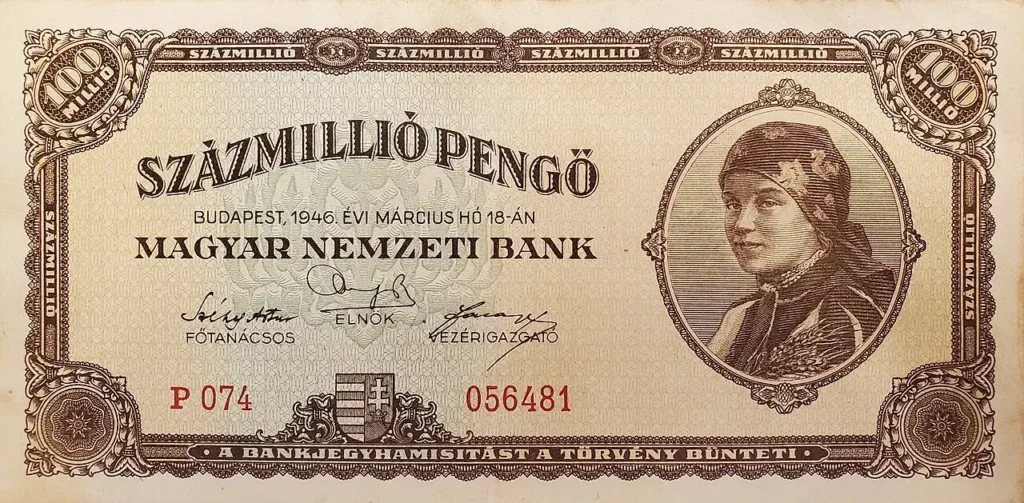
Hungary’s 1946 pengő collapse (their second collapse in just two decades) remains the most extreme inflation ever documented. At its peak, prices doubled roughly every fifteen hours. The pengő wasn’t debased, it was rendered meaningless, replaced within months by an entirely new currency. This is what “no anchor at all” looks like when it’s tested at full scale: a government facing occupation costs, war damage, and no gold discipline whatsoever chose the printing press because nothing else was constraining it from doing so.
China’s wartime and postwar currency collapse in the same decade tells a parallel story from an entirely different political system. As the Nationalist government fought a losing civil war against Communist forces, it financed the effort by expanding the money supply far beyond what the economy could absorb. The fabi currency, and later the gold yuan meant to replace it, both collapsed in rapid succession. Ordinary families who had held their savings in currency watched it become worthless in a matter of months, while those in physical assets fared differently.
Two continents. Two entirely different political systems, one a defeated fascist state and the other a collapsing nationalist republic. Yet the underlying mechanism was the same: total war finance, paired with a currency that had no physical constraint left to slow it down. That combination didn’t just produce collapse. It produced collapse on a timeline that would have been structurally impossible under any gold-linked system from the centuries before.
1971 and the Removal of the Last Anchor
For a few decades after World War II, the world operated under Bretton Woods — a system in which the U.S. dollar was convertible to gold, and other major currencies were pegged to the dollar. It wasn’t a full gold standard, but it was the last thread connecting the global monetary system to a physical constraint.
By 1971, that thread was under enormous strain. Decades of U.S. deficit spending and monetary expansion meant far more dollars existed than the gold reserves backing them could support. Foreign governments, sensing the mismatch, began redeeming dollars for gold at a pace the United States couldn’t sustain. Faced with the prospect of a gold reserve run to zero, President Nixon closed the gold window, suspending dollar convertibility.
It’s worth sitting with why this was a rational political choice, not a reckless one, from the perspective of the people who made it. Maintaining convertibility meant accepting a hard external constraint on domestic policy — one that limited how much a government could spend or print regardless of political pressure. Removing it meant regaining full discretion. Almost every government, given that choice under strain, would choose full discretion. That’s not a partisan question, it’s an incentive one.
What followed in the 1970s — stagflation, oil shocks, a decade of stubborn inflation — was the first real stress test of a fully unanchored global monetary system.
And it revealed something important. Without gold discipline anywhere in the system, currency management became purely a question of institutional trust and restraint.
Isolated Collapses in an Anchorless World: The 1990s
Here’s what 1971 didn’t do. It didn’t cause an immediate global collapse. Major currencies wobbled through the 1970s but held together. What the removal of the last anchor actually did was remove the floor, and floors only matter when something falls.
The 1990s supplied two demonstrations of exactly that, and they’re instructive precisely because neither required a world war to happen.
Yugoslavia’s hyperinflation between 1992 and 1994 arrived alongside the violent disintegration of the state itself. As the federation split apart amid war, the government financed itself the same way every collapsing regime in this article has: by printing money it had no other way to raise. Without any external monetary discipline — gold, a currency peg, or otherwise — the dinar’s collapse was total and fast, echoing Hungary’s pengő nearly half a century earlier almost exactly in shape, if not in scale.
Russia’s 1992 currency crisis followed a different script but landed in the same place. As the Soviet economy transitioned abruptly to a market system, price controls were lifted almost overnight, and the money supply expanded rapidly to cover a state apparatus in the middle of its own dissolution. The ruble’s value collapsed, and ordinary Russians who had spent a lifetime saving watched those savings become worth a fraction of what they had been within a matter of months.
Neither case involved a world war. Neither case involved a currency losing convertibility to gold — because by 1992, there was no convertibility left anywhere to lose. That’s the point. War and regime collapse had already been 20th century constants for decades. What changed is that, in an anchorless system, war and regime collapse alone were now sufficient to produce total currency failure, without needing the scale of a global conflict to get there.
What the Speed Tells Us
Lay the timeline end to end, and the pattern is hard to miss. Rome’s debasement played out over centuries. Medieval coin-clipping unfolded over decades. The currency crises of the early 20th century — Weimar, Austria, Hungary’s first inflation — took mere years. By the time you reach Hungary’s second collapse in 1946, or China in the same decade, or Yugoslavia and Russia in the 1990s, the timeline has compressed to months.
That compression isn’t a coincidence, and it isn’t a coincidence that it tracks almost exactly with the graudal removal of physical constraints on money — first loosened during World War I, then severed for good in 1971. Each step removed more of the brake. Each collapse that followed moved faster than the one before it.
None of this is a prediction. We don’t know if, or when, any specific currency faces this kind of stress next — nobody does, and anyone claiming certainty about it isn’t reading history carefully.
What the pattern does tell us is narrower and more useful. In a fully anchorless monetary system, the historical brake that used to buy families time to notice, adapt, and protect themselves no longer exists. So prepare accordingly.
Conclusion
The 20th century’s currency collapses aren’t a longer list of the same failures that came before them. They’re evidence of a change in kind. Physical debasement , which was slow, metallurgical, and bounded by how much silver a mint could shave off a coin, gave way to policy-driven collapse, bounded by nothing but institutional discipline and political will.
Weimar and Hungary’s first inflation showed what happens when that discipline weakens under wartime strain. Hungary’s second collapse and wartime China showed what total failure looks like once the anchor is gone entirely. 1971 removed that anchor for every currency on earth, not just the ones already in crisis. And Yugoslavia and Russia showed, a generation later, that in that kind of system, a currency doesn’t need a world war to fail — regime stress and institutional breakdown are enough on their own.
Families can’t change monetary policy. No one reading this can restore a gold anchor to the dollar or slow the pace at which modern currency crises unfold. But understanding why modern collapses move faster than their historical predecessors — and why they can now happen in isolation, not just during global conflict — is what turns hard assets from a reactive impulse into a considered position. That’s worth giving some thought to.
Image Credits:
Hungarian Pengo is licensed under CC-BY-SA 4.0


![The Rentenmark: How Hyperinflation Was Solved In Germany [And 6 Lessons You Can Learn From It]](https://www.hardmoneyhistory.com/wp-content/uploads/2022/09/rentenmark.webp)
