Disclaimer
This article is for informational and educational purposes only and does not constitute financial advice. The author may hold positions in the assets discussed. Any discussion on jurisdiction, exchanges or custody providers reflect the author's personal views and experiences and is not a personal recommendation. Always do your own research and seek professional guidance before making investment or custody decisions.
Last Updated on September 14, 2026
If you ask most people what nineteenth-century money looked like you’ll get a version of the same answer: gold-backed, disciplined, stable. A calm interlude between the chaos of revolutionary Europe and the chaos of the twentieth century’s world wars and hyperinflations.
That picture is true for about the last forty years of the period and almost entirely wrong for the first eighty.
The century opens with one of history’s fastest currency collapses. It runs through a president dismantling his country’s central bank and triggering a depression within a year. It includes a war financed with paper money that traded at a third of its face value.
And even after a coordinated gold standard finally took hold in the 1870s, the system spent the next four decades lurching from panic to panic. The “stable” era wasn’t stable. It was the best we have had but it was far from perfect.
Understanding why matters for anyone trying to figure out what a monetary system can actually promise, and what it can’t.
A Century Split in Two — And Neither Half Was Calm
First, a quick note on the timeframe. Historians don’t usually treat “the nineteenth century” as a clean 1800–1899 block. The “long nineteenth century” is a historiographical term for the period from the French Revolution in 1789 to the outbreak of World War I in 1914 — roughly 125 years that share a common political and economic character, bookended by two events that each reshaped the world that followed.
Monetarily, that longer window is more useful than the calendar century, because the currency story doesn’t start in 1800. It starts in Paris in 1789.
Split that window roughly at 1870 and you get two very different eras. The first eighty years have no coordinated monetary standard at all. Just competing metallic systems, political fights over money, and at least one outright currency collapse. The second forty years finally produce something resembling order: the classical gold standard, with major economies pegged to a common metallic anchor.
It’s the second half that gets remembered as “the” nineteenth century monetary story. That’s partly because the gold standard era left behind cleaner data, and it’s the system that directly preceded the twentieth century’s more famous failures, so it gets framed as the reasonable baseline those failures departed from. But the first half isn’t a footnote. It’s where most of the century’s actual currency chaos happened, and it set up every structural problem the second half would inherit.
The Assignat Collapse — France’s Revolutionary Paper Money Experiment (1789–1797)
The century’s opening currency crisis is also one of history’s starkest. In 1789, France’s revolutionary government issued the assignat — paper currency backed by confiscated church and crown lands. The logic was sound on paper: real assets backing real currency. The execution wasn’t. Facing a war and a treasury with no other way to fund it, the government simply issued more assignats than the underlying land could support.
Depreciation was gradual at first, then wasn’t. By 1795–1796, France was in outright hyperinflation. Rationing, black markets, and the collapse of ordinary savings followed, the same sequence that would recur in Weimar Germany a century and a half later. The assignat is usually taught as a French Revolution footnote. It’s better understood as the century’s opening data point: even a currency backed by real, tangible assets fails when issuance discipline fails. The backing was never the problem. The restraint was.
Bimetallism Under Strain — The Gold-Silver Ratio Wars (1803–1873)
While the assignat burned out fast, a slower-moving instability was building elsewhere. France’s 1803 bimetallic standard fixed gold and silver at a 15.5:1 ratio — an attempt to give the country the flexibility of two metals instead of one. It worked reasonably well as long as the market ratio between gold and silver stayed close to the official one.
It didn’t stay close. Gresham’s Law — bad money drives out good — meant that whenever the market ratio drifted from the official rate, whichever metal was officially undervalued got hoarded or exported, and the overvalued metal flooded circulation instead. New discoveries, changing supply, and shifting demand kept knocking the ratio around for decades, and each shock rippled through every economy tied to bimetallism.
This instability is what set the stage for the panics of 1819 and 1837 in the United States — a country that inherited the bimetallic problem without inheriting any coordinated solution to it. Bimetallism promised the discipline of a metallic anchor. What it delivered was a structural vulnerability to relative price shocks that no one had fully priced in.
Andrew Jackson, the Bank War, and the Panic of 1837
If bimetallism was instability by structural design, Jackson’s monetary policy was instability by conviction. In 1832, Andrew Jackson vetoed the recharter of the Second Bank of the United States, framing it as a fight against concentrated financial power. Whatever the merits of that argument, the practical effect was the removal of the closest thing the young republic had to a central monetary coordinator.
The consequences arrived on a delay. In 1836, Jackson’s Specie Circular required that public land purchases be paid in gold or silver rather than paper banknotes — an attempt to curb speculative lending that instead triggered a scramble for hard currency the banking system wasn’t prepared to supply. The Panic of 1837 followed within months, and the depression that trailed it lasted years.
This is the first-half pattern in miniature. Jackson’s stated goal was sound money — distrust of paper, distrust of concentrated banking power. But dismantling monetary infrastructure in pursuit of a principle produced exactly the instability the principle was supposed to prevent. Conviction about what sound money should look like is not the same thing as a functioning monetary system.
The Civil War Greenbacks — Fiat Money to Fund a War (1861–1879)
Three decades later, a modern nation-state reached for the assignat’s exact tool, under comparable pressure. Facing Civil War costs the Union’s specie reserves couldn’t cover, Congress passed the Legal Tender Act of 1862, authorizing unbacked paper currency — the greenback — that had to be accepted for most debts by law, but wasn’t redeemable in gold.
The market didn’t wait for legal tender status to render its verdict. Greenbacks traded at a discount to gold that widened and narrowed with the war’s fortunes — the “gold premium” functioned almost like a real-time confidence index, falling as low as roughly 35 cents on the gold dollar at the war’s low points. That’s a currency market pricing in doubt, in real time, the same way markets have priced in doubt about every fiat currency since.
What makes the greenback episode different from the assignat isn’t the mechanism — it’s the outcome. Rather than issuing its way into hyperinflation, the government committed to unwinding the experiment. The Resumption Act of 1875 set a path back to specie payments, formally achieved in 1879. It took the better part of two decades. But it happened. The greenbacks are the one episode in this history where discipline, once abandoned, was deliberately restored — proof that the outcome isn’t inevitable once a currency goes fiat, but that reversing it requires sustained political will, not just the passage of time.
The Latin Monetary Union and the Slow Death of Silver (1865–1878)
Europe’s answer to bimetallic instability was coordination. In 1865, France, Belgium, Italy, and Switzerland formed the Latin Monetary Union, standardizing their bimetallic coinage on France’s ratio in an attempt to create a stable, interoperable currency zone — an early experiment in monetary union that predates the euro by well over a century.
It worked only as long as the underlying gold-silver ratio held. New silver discoveries in the American West increased supply just as Germany, newly unified and flush with French war indemnity gold, demonetized silver entirely in 1871–73 and moved to a pure gold standard. Silver flooded into the Union’s members as other countries stopped absorbing it, and the whole arrangement began unwinding within a few years of Germany’s decision.
The Union’s failure illustrates something the assignat and Jackson episodes don’t: institutional coordination can’t outrun an incentive problem. Four countries agreeing on a ratio didn’t change what happened when a fifth country, acting in its own interest, made that ratio unsustainable.
The Panic of 1873 and the “Crime of 1873”
Germany’s demonetization of silver had a mirror image across the Atlantic. The Coinage Act of 1873 effectively demonetized silver in the United States too, moving the country toward a de facto gold standard just as it entered a severe deflationary depression — the Long Depression, sometimes called the Great Depression before that name was reassigned in the 1930s.
For farmers and debtors, deflation meant fixed debts becoming steadily harder to repay in real terms as prices fell. What looked, from a central banking perspective, like monetary discipline felt, from a farmhouse in Kansas, like a currency system quietly working against them. That grievance had a name — the “Crime of 1873” — and a political movement, free silver, built around reversing it.
This is the hinge point of the century. Everything before 1873 is chaos without a coordinated standard. Everything after is a nominally disciplined gold system — but a system whose discipline was already producing real winners and losers before its “golden age” had properly begun.
Panics of 1893 and 1907 — Credit Expansion Inside a “Stable” Gold Standard
The classical gold standard era is supposed to be the calm forty years. It produced two of the era’s most severe panics anyway.
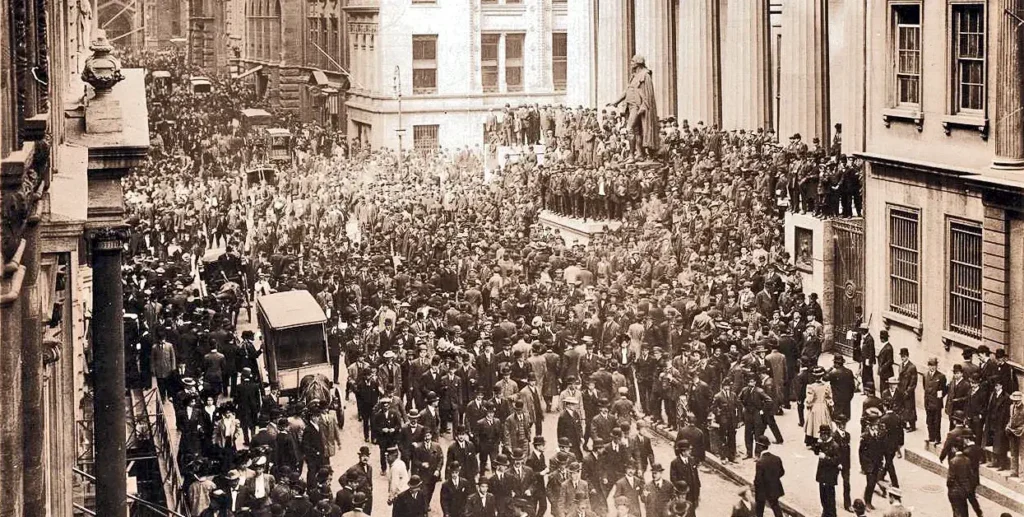
The Panic of 1893 combined fears over the U.S. gold reserve, driven partly by ongoing silver purchase obligations, with a broader wave of railroad overbuilding and business failures — echoes of the same railroad speculation that had triggered 1873. The Panic of 1907 arrived without even that excuse: a poorly regulated trust company failure spiraled into a full banking crisis with no central bank to act as lender of last resort, stopped only by J.P. Morgan personally coordinating a private bailout of the financial system.
Here’s the part that matters: gold convertibility constrains how much currency a government can issue. It does nothing to constrain how much credit banks can extend on top of that currency. Both 1893 and 1907 were credit cycles — lending expanding faster than the underlying economy could support, then contracting all at once when confidence broke. The metallic anchor held but the panic happened anyway.
1913 and 1914 — The Era Ends the Way It Lived
1907’s aftermath is precisely why the United States built a central bank. The Federal Reserve Act, signed into law in December 1913, created the institution 1837 and 1907 alike had shown was missing — a lender of last resort with the authority to expand credit in a crisis instead of relying on a private banker like J.P. Morgan to organize a rescue. It’s worth sitting with what that admission actually concedes: after four decades under a gold standard sold as sufficient discipline on its own, the system’s own architects decided it wasn’t, and built a human institution to backstop it.
They had almost no time to find out how it would perform under normal conditions. Within a year, the outbreak of World War I in August 1914 ended the classical gold standard outright. Belligerent European powers suspended convertibility almost immediately, needing to print and borrow at a scale gold discipline couldn’t accommodate, and the system never fully returned in its original form — later interwar attempts to restore it were partial and short-lived. The long nineteenth century’s currency story closes, fittingly, with the very anchor it spent forty years defending abandoned within days of the war that ended the era itself.
Conclusion
The long nineteenth century wasn’t a stable prelude to twentieth-century chaos. For most of its length, instability was the norm — a revolutionary currency collapsing outright, a president dismantling the institution meant to prevent exactly that kind of collapse, and a war financed with the same tool that had failed France a generation earlier. The final four decades imposed real, coordinated discipline through the gold standard. That discipline didn’t mean safety. It meant a different failure mode: credit cycles operating freely inside a system that constrained currency issuance but nothing else, producing 1893 and 1907 anyway.
The one clear success story in this history is the greenbacks — proof that a currency can walk back from fiat issuance to restored discipline. But it took seventeen years and sustained political commitment, not the mere existence of a rule on paper. Even the era’s final acts made the same point from the other direction: the Federal Reserve was built in 1913 because gold discipline alone hadn’t been enough, and the gold standard itself was gone within days of the war that closed the period a year later. The system that supposedly defined nineteenth-century monetary stability didn’t survive contact with the century’s own end.
That’s the pattern worth carrying forward, without predicting where it leads next: the format of money — paper, metal, or otherwise — has always mattered less than whether anyone was actually willing to enforce discipline within it.
Families navigating monetary uncertainty today are, in that sense, asking the same question farmers asked in 1873 and shopkeepers asked in Weimar — just with different instruments in hand.
Image Credits:
The Panic of 1907 is in the public domain